A practical guide to legal limits, payment checks, bonus terms and withdrawal details for offshore real-money pokies.

The first distinction to keep straight is between what the law says about an operator and what it says about a player. Under the Interactive Gambling Act 2001, companies cannot legally offer real-money online pokies to people in Australia without a domestic licence. No such licences have been issued, so there is no Australian-licensed online casino.
That does not mean the law treats a person who plays on an offshore site in the same way as the business running it. The Act targets operators, not individual players. Australians are not made criminally liable simply for playing on an offshore site that accepts them. The legal risk and the practical risk are different things: a player may not be the target of enforcement, but they are still dealing with a service that has no Australian casino licence.
For anyone considering online pokies for real money in Australia, this is the context that matters more than a site’s branding or the way it describes its credentials. A foreign licence, if an operator has one, is not an Australian licence. It does not change the position under the Interactive Gambling Act or create a domestic regulator responsible for that casino. There is no local online-casino licensing system that a reader can use to confirm that an offshore operator is approved to serve Australian customers.
Choosing an online pokies site for real-money play in Australia calls for a close look at the details you can verify, including licensing, deposit options and payout information. Use these notes as a starting point and check the terms that apply to you before signing up.
Lucky Dreams
Lucky Dreams lists a Curacao licence and a minimum deposit of A$20 via POLi. Those details give you a clear starting point for checking its eligibility and payment options.
Ricky Casino
Ricky Casino lists crypto payouts in under an hour and PayID payouts in 1–3 business days. The minimum deposit is A$20, or A$30 to qualify for the bonus.
Neospin
Neospin lists a Curacao Gaming Control Board licence, OGL/2023/176/0095, held by Hollycorn N.V. You can use the licence details as a reference when checking the operator.
Vegaz Casino
Vegaz Casino lists Curacao licence OGL/2024/1335/0780 and a minimum deposit of EUR 20. These specifics may help you assess its licensing and deposit requirements.
LuckyVibe
LuckyVibe lists a Curacao Gaming Control Board licence, OGL/2023/176/0095, held by Hollycorn N.V. You can refer to those details when reviewing the operator.
DragonSlots Casino
DragonSlots Casino lists a Curacao Gaming Authority licence, with Jumpman Gaming Ltd identified as the operator. That gives you a licensing detail to verify before playing.
SkyCrown
SkyCrown lists a Tobique Gaming Commission licence, a minimum deposit of A$30, and payout estimates of around 10–15 minutes for crypto and 1–5 days for fiat. These details can help you assess whether its stated terms suit you.
Uptown Pokies
Uptown Pokies lists a Curacao licence, says it has operated since 2017, and has a minimum deposit of A$20. These are the available reference points for your initial review.
SpinsUp
SpinsUp lists a Curacao Gaming Control Board licence, OGL/2023/174/0082, held by Dama N.V. You can use that information to check its licensing details.
7Bit Casino
7Bit Casino is listed as a Curacao-licensed casino operated by Dama N.V. Those are the licensing and operator details available for your reference.
The Act prohibits operators from providing real-money online casino games to people in Australia. Pokies fall within that category, alongside other casino-style games. The restriction is about the service being offered to someone physically located in Australia; a site’s location overseas does not, by itself, make the offer lawful here.
This can be easy to miss because an offshore website may be visible, accept Australian visitors or describe itself as licensed somewhere else. Those facts do not establish that it holds an Australian licence. There are no Australian online-casino licences to hold. A site’s willingness to take a customer is not the same as government approval to provide the service.
The distinction also explains why the player-facing experience can look ordinary while the legal position is not. A site may have familiar games and account pages, but that does not put it under Australian online-casino regulation. I would not treat a polished website, an Australian-facing page or a claim about an overseas regulator as a substitute for domestic authorisation.
At the same time, it is important not to overstate the position for players. The law’s prohibition is directed at companies providing the service, not at individual Australians who play. A person is not breaking the Act merely by visiting an offshore casino and playing there. That does not remove the risks of using a service outside Australia’s licensing system; it simply keeps the legal responsibility in the right place.
 Best pokies in Adelaide: venue and play checksLearn how to verify gaming-area hours, assess venue listings and understand the limits of “best” claims; general opening times may not confirm…
 Best Pokies in New South Wales: Venue GuideExplore NSW venue entry, machine-floor criteria, online access limits and location questions. Players must be at least 18 and show ID before…
The Australian Communications and Media Authority (ACMA) is the main domestic regulator enforcing the Interactive Gambling Act. Its role includes blocking access to illegal offshore gambling sites. Internet service providers are required to comply with ACMA’s blocklist.
A block can affect whether a site is reachable from an Australian connection, but it is not a certificate of safety or a complete account of a particular operator. Nor does a site being reachable mean it has been approved. Access and authorisation are separate questions. ACMA’s blocking activity is part of enforcement, not a system for endorsing offshore casinos.
That means the practical picture is not simply “the law bans it, so no one can see it.” Offshore services may attempt to reach Australian customers, while ACMA works to restrict access to illegal gambling sites. A reader should not interpret a working page as evidence that the operator has permission to provide real-money pokies in Australia. A page that stops loading, on the other hand, may reflect a block rather than a judgement about the player.
The regulator’s role is also not the same as customer support for an offshore casino. ACMA enforces the law; it does not turn an offshore operator into an Australian-licensed business or guarantee that a customer can resolve a dispute through a local casino regulator.
The most consequential point for a player is what happens if an offshore casino refuses to pay winnings. Australian players have no legal recourse in Australia in that situation. There is no domestic online-casino licensing authority overseeing the operator, and no Australian casino licence that gives the player a local route to enforce a claim against it.
That is a different issue from whether the player is personally breaking the law. A player may not be the target of the Act, yet still have little practical protection if a dispute arises. The absence of player liability should not be mistaken for a promise that winnings can be recovered, or that Australian authorities will resolve an account dispute with an offshore business.
I would keep those two points together when weighing the decision: the law targets the company, but Australian players do not have local legal recourse if an offshore casino withholds winnings. One does not cancel out the other. “The player is not prosecuted” and “the player is protected” are not interchangeable claims.
A site’s own terms may set out how it says it handles disputes, but those terms do not create an Australian licence. Likewise, an overseas licence does not supply the missing Australian oversight. The key question is not only whether a service will accept a player, but what protection is actually available if the relationship goes wrong. For offshore real-money play, that answer is limited in Australia.
The legal age for gambling in Australia, including online pokies, is 18. That age requirement does not depend on whether the service is based overseas. Anyone under 18 should not gamble.
 Best pokies in Melbourne: venues, hours and locationsCompare Melbourne pokies venues by area, check location details and opening hours, and understand what “best” can mean before planning a visit.
 Pokies in Canberra: What to Check Before You GoLearn how to verify Canberra venue hours and whether the gaming area is operating, plus what to check for airport, CBD and…
For adults, the law leaves a clear but uneasy distinction: operators are prohibited from offering real-money online casino games to Australians without a domestic licence, and no domestic online-casino licences have been issued; individual players are not the ones the Act targets. ACMA enforces the law and blocks illegal offshore gambling sites, with internet providers required to follow its blocklist. Yet an offshore site may still accept Australian customers, and access alone tells you nothing about its Australian status.
So when you see claims about online pokies for real money in Australia, read them in that context. There is no locally licensed online casino behind those offers, and Australian players have no local legal recourse if an offshore operator refuses to pay. That is the central trade-off—not a small-print technicality.
PayID can make a bank transfer feel straightforward: instead of entering a long account number, you use an alias such as an email address, mobile number or ABN. PayID sits on top of Australia’s New Payments Platform (NPP), the payment network that carries the transfer. Major Australian banks support the NPP, and it uses end-to-end encryption.
That describes the payment rail, not the business on the other end. An encrypted transfer can still go to a merchant whose terms, ownership or handling of disputes you have not checked. Seeing PayID listed beside a deposit option does not establish that an online casino is licensed, that its games are fair, or that it explains its pokie settings transparently. The payment method cannot answer those questions.
To use PayID for real-money play at an online casino, you first need to link your PayID to a bank account. The bank account is what makes the transfer possible; PayID is the alias used to address it. If you have not set one up, look in your bank’s own app or online banking for its PayID registration instructions. Do not assume that a casino can create a PayID for you or link one to your account.
Before confirming any transfer, check the recipient information shown by your bank against the payment instructions you have been given. Read the amount and recipient carefully, and stop if they do not match. A transfer that has been sent to the wrong recipient is not made safer by having started with a familiar payment method.
There is another practical snag: a bank may decline a transfer connected with gambling. A specialist review has reported that some Australian banks, including members of the Big Four, sometimes block PayID transfers to known gambling merchants. That is a report about bank practice, not a promise that a particular transfer will work—or that every bank treats every merchant the same way. Your bank controls its own payment decisions, and a declined transfer is a reason to check with the bank, not to keep trying different routes around its controls.
PayID’s convenience can blur an important distinction. A payment service and the recipient are separate things. The NPP’s security features protect the transfer in transit; they do not verify the recipient’s business practices, settle a complaint about a refused payment, or certify a pokie’s return settings. A neat payment screen is not due diligence.
If a casino’s payment page says PayID is accepted, read the deposit terms there as well. Check how the recipient is identified, whether the instructions are clear, and what the operator says happens if a transfer is delayed or rejected. The terms should make it possible to understand what you are authorising before money leaves your bank account. If the instructions are vague or inconsistent, do not treat the speed or familiarity of PayID as a reason to proceed.
One specialist review describes PayID as being treated like other qualifying deposit methods at the sites it covers. That is a statement about those sites and that review, not a general rule for every casino or a permanent feature of the market. Payment options and operator terms can change. Check the current terms for the specific service rather than assuming that PayID will be handled in a particular way.
Keep your own bank records and any payment confirmation. They can help you identify what you sent and when, though they do not guarantee that a merchant will resolve a dispute in your favour. If a payment is unfamiliar, unexpected or inconsistent with what you authorised, contact your bank promptly through its official channel.
PayID is also not a responsible-gambling safeguard. BetStop applies to Australian-licensed operators; it does not bind offshore sites. A payment choice cannot take the place of deciding whether to spend, setting your own boundaries, or stopping when you have reached them.
The useful way to think about PayID is simple: it is a bank-linked way to address a transfer using an alias. It can reduce the account details you need to enter, but it does not turn the recipient into a trusted operator. Keep those two checks separate.
A free version of a pokie can be useful for getting familiar with its layout. You can see where the spin control sits, how the game displays its symbols and what happens when you open its menus. But no cash is at stake, and nothing you see in that mode tells you what a later session with money will bring.
That distinction sounds obvious until a free game produces a run of wins. It is tempting to read that run as a sign that the pokie is generous, or to think you have learnt when a good result is due. You have not. Each spin is generated as a separate random event, so the result of one spin does not set up the next. A win in free play is not a preview of a cash win, and a string of losing spins does not mean a win is now owed.
Used sensibly, free play is a way to inspect the experience without staking money. You can get a feel for the screen, check how the controls work and see how the game presents its features. That may help you decide whether you enjoy the pace or find the presentation confusing.
It cannot establish what you will win when you play for real money. A sample of spins, whether it feels lucky or not, is still just a sample. The game’s random results do not become predictable because you have watched a few rounds or pressed the spin button yourself. I would treat free mode as a look around, not a test run for future cash play.
There is another important limit: what you see in free mode is not proof of every condition that applies to a money session. A familiar title or matching screen does not, by itself, tell you everything about how it will operate elsewhere. Keep the claim modest: you have seen the game’s presentation, not established what a real-money session will return.
To play pokies online for real money is a different decision because your own funds are at risk. Free play and paid play may look similar on screen, but the consequences are not. A virtual balance can be reset; money you stake cannot be treated as practice credit.
That is why I separate two questions. First: do I understand the game well enough to use its controls? Free play may help with that. Second: can I predict the result of a cash spin from what happened in free mode? No. The random process gives you no reliable signal from earlier results.
The same applies if you search for free pokies for real money. Those words describe two different things, not a special category where spins cost nothing but still produce withdrawable cash. If no money is being staked, it is free play; if money is being staked, it is real-money play. Read the terms attached to an offer separately rather than assuming that “free” means any winnings can simply be taken as cash. The details of offers are a different matter from what a free demonstration can tell you about the game.
People are good at spotting patterns, including in random results. A few similar outcomes can feel meaningful, and a near miss can make the next spin seem promising. Neither changes the next result. The RNG determines each spin independently; the last one does not make the next more likely to land a particular way.
So, if you are comparing free online pokies with play for money, compare the parts free mode can actually show: the interface and whether you like the game’s feel. Do not use a lucky demo streak as a reason to stake cash, or a cold one as evidence that a payout is overdue. There is no dependable lesson in either.
Free play can answer a small question: “Do I want to spend time with this game?” It cannot answer “Will I win when money is involved?” Those are not the same test. Keep that line clear, and the word “free” will not do more work than it should.
A balance on screen is not the same as money in your bank account. Before you stake anything, find the withdrawal rules and read the parts about verification, payment limits and how a large win is released. If you wait until after a win to look, you may discover conditions you would have wanted to know earlier.
A specialist review reports that some casinos set weekly or monthly withdrawal ceilings between $5,000 and $10,000. With a $50,000 jackpot, a cap in that range could stretch payment over years rather than produce one transfer. That is a reported example, not a rule that applies to every site. The practical point is to check whether a limit applies per transaction, per week or per month, and whether it changes for larger balances.
Look for the exact wording in the withdrawal terms. A limit may affect how much you can request at once, while the timing and handling of any remaining balance may be covered elsewhere. If the rules are unclear, ask the operator to explain them in writing before you play. A vague answer is not a useful answer.
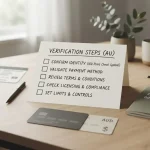
Identity checks can also stand between a win and a withdrawal. A specialist review describes identity verification before a first cash-out as a common requirement, with requests potentially including a photo of your ID, proof of address and, in some cases, a selfie holding your ID. Treat this as a step to complete and understand before you need to withdraw. Check which documents are accepted, how to submit them securely and whether the details on your account must match your documents.
Do not send identity documents through an improvised channel just because someone in a chat asks for them. Use the stated account-verification process and keep a record of what you submitted and when. If the operator requests more information, check that the request comes through its official account area or a contact method listed in its terms.
The phrase “win real money online pokies” can make the moment of winning sound like the finish line. It is only one part of the process. You still need to meet the operator’s checks and request a withdrawal under its rules. This is why I would read the cash-out terms before treating a displayed balance as money you can access.
If you use BetStop, remember that it applies to Australian-licensed operators and does not bind offshore sites. It should not be relied on to restrict access to an offshore casino account.
Keep the decision simple: understand the withdrawal cap, prepare the required identity and address proof, and know how the operator handles the rest of a large balance. If those details are hard to find or make no sense when you ask, pause. A win you cannot readily withdraw is a poor surprise.
A no-deposit offer can sound like a way to try real-money pokies without putting in your own cash. The headline is only one part of the deal. Before treating any advertised bonus as money you can keep, find out what wagering requirement applies, what balance it is calculated on and whether winnings from free spins have a cash-out cap.
A wagering requirement is a turnover rule: you must place bets totalling a stated multiple of the qualifying bonus before its winnings become withdrawable. It does not mean you will earn that amount back. The required bets can consume a balance along the way, and meeting the turnover condition does not guarantee a profit.
The calculation changes depending on the terms. A specialist review uses a $500 bonus with a 40x requirement to illustrate the scale: the required turnover is $20,000 if the multiple applies to the bonus alone. If a 35x requirement applies to a $500 deposit plus a $500 bonus, the calculation is $35,000 in bets. Read the wording carefully; “bonus only” and “deposit plus bonus” produce different obligations.
That is a lot of turnover. A specialist review advises looking for requirements of 35x or less and describes anything above 40x as punishing. Treat that as a screening guideline, not a promise that a lower multiplier makes an offer worthwhile. The other terms still matter, and a bonus may have conditions beyond the wagering figure.
No-deposit real-money pokie offers can also come with rules about which games count towards turnover, how long the offer remains available and what happens if you withdraw before completing the requirement. Those details are specific to the offer, so do not assume that a headline amount tells you the full deal. If the terms do not clearly explain how the requirement is worked out, the sensible move is not to guess.
Free spins have their own catch to check. A specialist review notes that an offer may cap the winnings that can be cashed out. So even if the spins produce a larger balance, the amount eligible for withdrawal may be restricted by the offer’s conditions. Look for that cap alongside the wagering rule, rather than after you have already accepted the promotion.
I would read the terms in this order: what amount the multiplier applies to, which bets count, whether there is a completion deadline, and whether winnings are capped. Keep the offer’s wording available so you can compare it with the balance shown in your account. “Free” is not the same as unrestricted.
Wagering Calculations
Bonus Only
A $500 bonus with a 40x requirement requires $20,000 in total bets.
Deposit plus Bonus
A 35x requirement applied to a $500 deposit and $500 bonus requires $35,000 in bets.
A phone screen can make a gambling service feel simpler than it is. Before using any real-money pokie service on mobile, check what you would need to do to register, set limits, and request a withdrawal. A polished page or an app icon does not tell you how those processes work. I would treat claims about an app’s convenience as claims to verify, not as a reason to sign up.
First, establish what you are actually opening. A service may be presented through a browser, an app, or both, but do not assume that a particular operator has a genuine app or that its mobile version includes the same functions as its desktop site. Check the operator’s own current information and be wary of lookalike apps or links from unfamiliar sources. If the available information is vague about who runs the service, that is a reason to stop and look more closely—not to hand over personal details.
Then look for practical controls before you create an account. Deposit limits can restrict how much you put in; loss limits can help restrict losses; session time limits can put a boundary around how long you play; and self-exclusion can block access. These are standard responsible-gambling tools, but their presence and operation should be checked on the service you are considering. Find out where the controls are, whether they can be set from a phone, and what happens when you try to change or remove one. A control you cannot locate when you need it is not much of a control.
Keep those checks separate from the question of whether the service is lawful. In Australia, there is no domestic licence for online casinos, and BetStop applies only to Australian-licensed operators; it does not bind offshore gambling sites. Do not treat a phone app, an Australian-facing page, or the availability of a particular payment option as proof that an offshore service is locally licensed or covered by BetStop.
The small screen also makes it easy to leave account checks until later. That can cause trouble when you want to withdraw. A specialist review reports that an operator may ask for identity verification before a first withdrawal, including images of identity documents and proof of address; some may also request a selfie holding an identity document. Check the operator’s requirements before depositing, and make sure you can provide the requested identity and address proof. Do not assume that signing up on a phone means you can skip those checks.
If you are asked to upload documents, pause long enough to check that you are using the operator’s genuine, secure account process. Avoid sending identity documents through an unsolicited message or an address you cannot verify. Read the instructions carefully and check that the details on your account match your documents. A mismatch can turn a straightforward verification step into a delay.
I would also check what happens if you want to stop playing. Look for a clear route to self-exclusion and to account support, rather than relying on a buried link or a promise that help is available. If you set a limit, make sure you understand how it works on mobile and whether it applies to the account rather than only to one device. Switching from a phone to a computer should not be treated as a way around a limit.
Mobile play is still gambling, not a different kind of outcome. Each pokie spin is an independent random event, so a previous result on your phone does not make a later spin due. The convenience of carrying a screen around can make it easier to keep going without noticing how long you have been playing. Set a session boundary before you start, and stop when you reach it. No clever shortcut.
A careful mobile check is not a recommendation to use an online casino. It is a way to avoid mistaking a tidy interface for meaningful safeguards. If you cannot confirm who operates the service, how to set its controls, or what documents it will require before a withdrawal, leave it there.
A new pokie, or a newly available site, can look like a fresh chance at a better return. That impression is not evidence. A specialist review reports that some game providers let casinos choose between different return-to-player (RTP) settings for the same pokie. So the title alone does not tell you which setting is in use.
I’d check whether the casino publishes the RTP for the exact game version it offers, rather than relying on a general figure attached to the game elsewhere. If the setting is not clearly stated, you cannot safely assume it matches another casino’s version—or that a new arrival has a higher return. “New” describes availability, not value.
The distinction matters even when the game looks identical. A familiar name and artwork can conceal a different selected setting, while a promotional description may not make that detail clear. Read the game information alongside the casino’s terms, and treat an unsupported RTP claim as just that: unsupported.
The same caution applies to a new site that accepts PayID. That payment option tells you how a deposit may be made; it does not establish which RTP setting a pokie uses. Keep the questions separate: payment details on one hand, game settings on the other.
There is no need to chase every new launch. If you cannot confirm the setting for the pokie you intend to play, the sensible conclusion is that you do not know its stated return. New is not better by default.
“PNG pokies” can mean different things: pokies intended for people in Papua New Guinea, a site claiming to operate from there, or simply a label used to attract players. The wording alone does not establish which meaning applies. It also does not verify that a particular operator is based in Papua New Guinea, accepts Australian players, or offers any specific game.
Treat claims about location and access as claims to check, not proof. A country name in a site address or page heading does not confirm where a company is registered or which rules govern its services. Nor does it establish that a pokie is available, that its settings are known, or that its stated return information is accurate. A game title and an operator’s description are not independent verification.
For an Australian reader, the PNG label does not change the need to understand who is providing the service and what practical protections apply. BetStop applies to Australian-licensed operators; it does not bind offshore sites. That distinction matters if you use self-exclusion as a safeguard.
I would not treat “online pokies in Papua New Guinea” as a reliable category by itself. Without a clearly identified operator and independently checkable details, the label tells you little about the service behind it. Keep that uncertainty separate from claims about a game’s performance or a site’s trustworthiness. The name is not evidence.