A practical guide to legal exposure, SOL transfers, game terms and the limits of what casino claims can verify.
You can buy, hold and transfer SOL in Australia. That does not mean an offshore operator can lawfully run an online casino for you here. Under the Interactive Gambling Act 2001, offering online casino games to people in Australia is prohibited for overseas operators. The restriction concerns the service being provided, not whether the customer pays with dollars, SOL or another crypto asset.
That distinction is easy to miss when a site accepts Australian visitors or displays crypto payment options. Access to a website is not proof that its service is lawful in Australia. The Australian Communications and Media Authority (ACMA) enforces the Act and can block access to unlicensed offshore gambling sites. A site loading on your screen does not amount to approval.
The Act is directed at operators, rather than making an individual punter liable simply for using an offshore casino. That does not turn the arrangement into a legally safe one. No prosecution of a player is not the same thing as a lawful service, and enforcement or access can change. “I can open the page” is a poor legal test.
When comparing Solana casinos in Australia for 2026, it helps to check the available details on licensing, deposits and payout methods before deciding where to play. Use these concise notes as a starting point for your own checks.
Lucky Dreams
Lucky Dreams lists a Curacao license and a minimum deposit of A$20 via POLi. Check whether those details suit your payment preferences.
Ricky Casino
Ricky Casino lists crypto payouts in under an hour and PayID payouts in 1–3 business days. The minimum deposit is A$20, or A$30 to qualify for the bonus.
Neospin
Neospin lists a Curacao Gaming Control Board license, OGL/2023/176/0095, held by Hollycorn N.V. You can use the license detail as a starting point for checking its credentials.
Vegaz Casino
Vegaz Casino lists Curacao license OGL/2024/1335/0780 and a minimum deposit of EUR 20. Consider these details when reviewing its terms.
LuckyVibe
LuckyVibe lists a Curacao Gaming Control Board license, OGL/2023/176/0095, held by Hollycorn N.V. Its listed licensing detail is the main factual point to consider.
DragonSlots Casino
DragonSlots Casino lists a Curacao Gaming Authority license, with Jumpman Gaming Ltd as the operator. Check that licensing information as part of your research.
SkyCrown
SkyCrown lists crypto payouts at around 10–15 minutes and fiat payouts in 1–5 days. Its minimum deposit is A$30.
Uptown Pokies
Uptown Pokies lists a Curacao license, has been operating since 2017, and has a minimum deposit of A$20. These details offer a concise starting point for your checks.
SpinsUp
SpinsUp lists a Curacao Gaming Control Board license, OGL/2023/174/0082, held by Dama N.V. You can verify the license details as part of your review.
7Bit Casino
7Bit Casino lists a Curacao license and is operated by Dama N.V. Its operator and licensing details are the available points to check.
There is another gap that matters if something goes wrong. If an offshore Solana casino freezes your account or refuses to release winnings, you have no protection under Australian law for that dispute. You cannot assume Australian authorities will make the operator pay, restore your balance or resolve a disagreement on your behalf. The operator may be outside the practical reach of local consumer remedies, leaving you with few effective options.
That risk is separate from whether SOL itself is lawful to own. Holding and transferring the asset does not create an Australian gambling licence for the business receiving it. Nor does a crypto payment method change the nature of the service. The legal question is not just what moves across the network; it is whether an offshore operator is providing prohibited casino gambling to a person in Australia.
A specialist review has reported that Australia still had no specific licensing framework for crypto-gambling operators by mid-2026. Treat that as a time-sensitive account, not as permission to use a site. More importantly, an offshore licence or a site’s own claims do not override the Australian prohibition on operators providing online casino services to residents here.
Using a VPN does not fix the legal position. It may also breach an operator’s terms and can put your account and funds at risk if the site responds by seizing or withholding them. Concealing your location is not a consumer-protection measure.
So, if you are comparing Solana casinos from Australia, keep the legal boundary in view before considering anything else: SOL transfers are lawful, but offshore online casino services are prohibited from serving Australian residents. The player is not directly penalised under the Act, yet that is not a guarantee of safety, access or recourse. A balance on a screen can become a dispute with no useful local remedy. The distinction matters.
The route is less like paying a casino directly from your bank account and more like moving value through several separate services. You fund an Australian exchange, buy SOL, send it to a wallet accepted by an offshore site, and later reverse the process if you want Australian dollars back. Each hand-off has its own checks and risks.
There is an important legal point before the practical steps: the Interactive Gambling Act 2001 prohibits offshore operators from offering online casino games to Australian residents. A site being reachable, or a player not having been prosecuted, does not make using it legally safe. I would not treat this as an ordinary local payment option.
Start by checking what the exchange supports for your account and how it handles deposits and withdrawals. Swyftx, CoinSpot and Coinbase AU support Australian-dollar deposits by PayID or bank transfer. These are ways to fund an exchange account, not a way to deposit Australian dollars directly into most Solana casinos. Most do not accept a direct bank-transfer or credit-card deposit; the player first buys SOL on an Australian exchange.
The exchange is also where identity checks can arise. Services converting between SOL and AUD are subject to KYC and anti-money-laundering requirements, so be prepared for an on-ramp or off-ramp to request identity details. Passing a casino’s own checks, if required, does not replace the exchange’s checks. They are separate services, with separate account rules.
Once you have SOL, you need a wallet that can send it to the casino’s stated deposit address. Before moving anything, confirm that the site accepts SOL and that the address and network shown are the ones you intend to use. Copying an address is not a substitute for checking it. A transfer sent to the wrong address can be permanently lost, and SOL transfers are irreversible: there is no routine bank-style chargeback to undo a mistake.
The casino will show a deposit address or another wallet connection method. Follow the instructions on the site, and check the currency and network carefully before confirming the transfer. A matching ticker alone is not enough if a service offers multiple assets or networks. Keep the exchange confirmation and transaction details so you can trace what you sent if the casino balance does not update as expected.
After the transfer, the casino has to credit the account. A confirmed on-chain payment does not guarantee that the operator will accept or credit it promptly; the operator controls its account system. If a deposit seems stuck, check the transaction status first, then use the operator’s stated support channel. Do not send a second payment just because the first has not appeared on the screen.
Do not try to solve access problems with a VPN. An operator may treat that as a breach of its rules, and the result could be account seizure and loss of funds. It is a poor fix for a problem that may already involve money you cannot recover.
Once credited, SOL may be shown as a balance for play. Keep track of what is held in the casino account, rather than assuming the wallet still controls those funds. A casino balance is subject to the operator’s account decisions. SOL’s price can also move while you are playing or waiting to withdraw, so the same number of coins may be worth less in Australian dollars later.
Read the cash-out terms before depositing, not after a win. Check how withdrawals are requested, whether the casino can ask for documents, and what conditions apply to funds in the account. Larger withdrawals or bonus cash-outs may trigger KYC checks that require identity documents. An operator can also have its own processing queue even after the blockchain transfer is ready to be sent.
If you take a bonus, understand its conditions before accepting it; a displayed balance may not all be immediately withdrawable. Keep records of deposits, play and withdrawal requests. If an account is frozen or winnings are withheld, users of offshore casinos have limited consumer protection and no recourse through Australian authorities for recovering those funds. That is the part people tend to discover too late.
A withdrawal generally moves from the casino to your wallet first. From there, you can send SOL to an exchange that supports withdrawals to AUD, then request payment to your bank. The casino’s processing time and the network transfer are distinct stages. Published processing estimates range from minutes for automated handling to as long as several days where requests are reviewed manually; those figures are not a promise for any particular operator.
If the withdrawal has not arrived, identify which stage is pending: casino approval, the transfer to your wallet, or the exchange’s conversion and bank payment. A blockchain transaction record can confirm that a transfer was sent, but it cannot make an operator approve one. Keep your wallet address and transaction information secure, and avoid sharing recovery phrases with anyone claiming to help.
In short: exchange, wallet, casino, wallet, exchange. The steps sound tidy. The recovery options are not.
I’d start with the awkward part, not the welcome offer: offshore operators are prohibited from providing online casino games to people in Australia under the Interactive Gambling Act 2001. An offshore site’s claims about licensing do not make it lawful to offer those services here, or give you Australian consumer protection. If an account is frozen or winnings are withheld, you have no legal protection under Australian law for resolving that dispute. That is a serious gap, not fine print.
Look for the licensing authority, the licence number and the legal company named as the operator. Then ask whether those details can be checked against the authority’s own records. A badge or a line saying “licensed” is not enough on its own; the claim needs to identify who issued the licence and which company it covers.
Treat a foreign licence as information about the operator’s stated oversight, not as a guarantee of access to Australian remedies. In particular, don’t confuse a licence disclosure with permission to provide online casino games to Australian residents. The legal position here remains the same regardless of how polished the site looks.
I would also check that the company named in the terms is the same one named in the licensing information and payment rules. If those names do not line up, or the site gives you no clear way to identify the responsible entity, you have little basis for working out who is accountable.
RTP, or return to player, is a long-run statistical measure for a game. It does not predict what will happen in your session or promise that you will get a particular amount back. If a site displays an RTP figure, check whether it is tied to the specific game and version being offered, and whether the operator explains where the figure comes from.
A number without context is decoration. Look for a clear explanation of whether the figure is supplied by the game provider or tested independently, and whether the site gives you enough detail to check it. If the explanation is vague, don’t treat the displayed RTP as proof of a favourable outcome.
A provably fair label is useful only if the site explains how to verify a result. Look for an accessible description of the process, what information you can inspect, and how you can use it to check a completed round. A technical-sounding label without a working verification method does not let you establish that a result was fair.
Keep the claim in proportion, too. A fairness tool may help you check game results; it does not establish that the operator will honour a withdrawal, resolve an account dispute fairly or provide Australian legal protection. Those are separate questions.
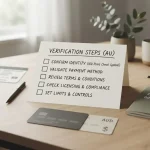
Check when KYC checks can happen, what documents may be requested, and whether verification can be required before a withdrawal is approved. Larger withdrawals or bonus cash-outs may trigger ID checks. If you only discover that after a win, you may be asked to provide documents before funds are released.
The terms should explain how the operator handles a pending withdrawal during a review and what happens if you cannot satisfy the request. Don’t assume that a quick deposit means a quick cash-out: withdrawal timing depends on the casino’s internal processing as well as network congestion.
Before sending SOL, find the rules for withdrawal fees, minimums, limits, bonus eligibility and any account restrictions. Some casinos add a withdrawal charge of 0.1% to 1% of the amount, so check the operator’s own terms rather than assuming the network fee is the only cost. Confirm whether the fee is shown before you submit a withdrawal.
Bonus wording deserves the same attention. If you accept an offer, work out what must be wagered, which games count towards progress, how long you have and whether a maximum cash-out applies. A bonus balance is not automatically withdrawable: money won from bonus funds may need to be played through with real-money wagers before it can be cashed out. The apparent value depends on the playthrough, game contribution, time limit and cash-out cap together—not on the headline offer alone.
Read these conditions before depositing, not after a win. If the rules are scattered, contradictory or open to broad operator discretion, that uncertainty belongs in your decision.
If a comparison or review page includes partner links, it should say plainly that they are affiliate or promotional links. That disclosure helps you judge whether a recommendation may earn the publisher a commission. It does not prove the casino is suitable, and it does not replace checking the licence claims, game information, KYC policy and cash-out terms yourself.
I’d treat any “best” label as a starting point for scrutiny, not a safety rating. A tidy site and confident promises cannot fill the protection gap. Check the details before you send SOL.
Solana can make the on-chain part of a payment feel almost immediate. A specialist technical review puts transaction confirmation at about 400 milliseconds, with balances updating straight away. That can be useful when you want a payment to register without waiting through a long chain of confirmations.
The network fee is small, too. A reported average is $0.00025 USD per transaction, effectively near-zero for an individual transfer. That is the cost of using the network, not a promise that a casino will charge nothing. An operator may apply its own fees or set payment conditions separately.
Here is the distinction I keep in mind: Solana moves the transaction; the casino controls what happens around it. A confirmed transfer does not mean an account has passed the operator’s checks, a withdrawal has been approved, or a payment has been queued. Withdrawal timing can depend on the casino’s internal processing as well as network congestion. A quick chain cannot hurry a manual review. Not the same clock.
Speed also does not make a transfer reversible. If you send SOL to the wrong address, the funds can be lost permanently. Check the destination before confirming, even when the wallet makes the payment feel routine. Fast mistakes are still mistakes.
Nor does a low fee protect the value of the funds. SOL’s market price can move while money is held or being withdrawn, so a small network charge says nothing about the AUD value you ultimately receive. The network handles the transfer, not the exchange rate.
The same boundary applies to account decisions. Larger withdrawals or bonus cash-outs may trigger KYC checks, including requests for identification. Those checks are controlled by the operator, not Solana. Using a VPN may also lead to an account seizure and loss of funds; network speed offers no remedy if that happens.
So the practical benefit is narrow but real: Solana can make transfers quick and inexpensive on-chain. It cannot make an offshore operator trustworthy, guarantee a withdrawal, or provide Australian consumer recourse if funds are withheld. Read the cash-out terms before depositing, not after a balance appears.
A slot bonus is not the same as withdrawable cash. If a win comes from bonus funds, the casino may require you to wager it with real money before you can cash out. The balance can look generous while still being locked behind a playthrough condition.
Start by finding out what the wagering multiple applies to: the bonus alone, or the bonus and your deposit together. Then calculate the required turnover before you accept. For instance, a 40x requirement on a 5 SOL bonus means placing 200 SOL in bets before withdrawal is allowed. That is the total amount wagered, not a request to deposit another 200 SOL. Still, every bet carries risk, and turnover is not profit.
The game’s contribution rate changes how quickly that requirement is met. Slots typically count at 100%, so each eligible bet adds its full value to wagering progress. Table games such as blackjack or roulette may count at only 10–20%. A bet that appears to move the meter by its full amount might therefore make much less progress on those games. For a bonus tied to slot play, check which games qualify and whether any exclusions apply.
The headline multiplier alone tells you little. A lower multiple on a larger qualifying balance can require more total wagering than a higher one on a smaller bonus. Restrictions on bet size or eligible games can also affect whether you can complete the requirement on the terms you expected. Read the conditions before playing, not when you are ready to withdraw.
Free spins need a separate check. Their winnings may be credited as bonus funds rather than cash, with another wagering condition attached. A specialist review describes a 50x requirement as one possible term for free-spin winnings; it should not be treated as a standard condition. Check the specific offer for the amount the multiplier applies to and whether the resulting winnings have their own deadline or withdrawal cap.
That matters when comparing slot offers on a casino that accepts SOL. A large number of spins or a sizeable bonus is not useful if the attached turnover is hard to complete, or if the winnings remain restricted after the spins end. The value lies in what the terms let you keep, not the balance shown while the bonus is active.
I would do the arithmetic first: identify the wagering base, multiply it by the requirement, then check the slot contribution rate and any limits that could block progress. If the terms are unclear, treat the bonus as unavailable rather than counting it as part of your bankroll. Read the small print.
NFTs and casino tokens are easy to fold into a single story about Solana: connect a wallet, collect a digital item, earn a platform token, then use both around the casino. I would not treat that as a standard package. The existence of a casino that accepts Solana does not, by itself, establish that it offers NFTs or its own token, or that either has a practical role in play.
An NFT is a distinct digital token. That description alone tells you very little about what an operator might do with one. It could be presented as a collectible, linked to an account feature, or simply have no casino use at all. Those possibilities are not evidence that a particular casino provides the feature. Before giving an NFT any value in your decision, look for clear operator terms explaining what it does, whether it can be transferred, and what happens if the platform changes or closes. If those details are absent or vague, do not fill the gaps with assumptions.
The same caution applies to a so-called casino token. A label is not a promise of utility. It does not tell you whether a token is needed to play, whether it provides a benefit, how any benefit is calculated, or whether you can exchange it for anything. Promotional language can make a token sound like part of the product when it may simply be an optional digital asset. Read the actual terms, and separate claims about a token from facts about the casino’s games and payment options.
That distinction matters because crypto language can make a feature feel more concrete than it is. A wallet connection is not proof of an NFT programme. A token name or graphic is not proof that holding it changes your account. And a claim that an asset has value does not establish that you can use or redeem it on the terms you expect. I would want the operator to explain the feature in plain language before counting it as a reason to trust the platform.
There is a more specific point worth keeping separate: a specialist casino review reports that some casinos support deposits and play using USDC on Solana as well as SOL. That is a payment option, not evidence of an NFT feature or a casino-issued token. It also does not mean every casino accepts USDC, or that an operator handles it in the same way as SOL. Check the payment information for the specific service rather than assuming that support for one asset means support for another.
USDC on Solana is still a digital asset being used on a particular network. Do not confuse the name of the asset with the network, or assume that a wallet or casino supporting SOL will automatically accept USDC. The deposit instructions should state the asset and network together. If they do not, pause rather than choosing an option based on a similar-looking name. Sending funds using the wrong asset or address can lead to permanent loss.
This is also why a casino with Solana payments should not automatically be described as an NFT casino. The payment rail and optional platform features are different questions. A casino may accept SOL without issuing any token of its own; a reference to NFTs would need separate, explicit terms. I would keep those claims in separate boxes when comparing what a platform says it offers.
When an operator advertises NFTs or a native token, look for the practical details, not just the headline. Is the item required to access a feature, or is it optional? Does the operator explain its role and any conditions in accessible terms? Are there limits on how it can be used or withdrawn? If the explanation depends on broad promises about future benefits, treat those as promises, not current utility.
Also consider who benefits from the promotion. If a page uses affiliate or promotional links, that relationship should be clearly disclosed. An endorsement attached to a token or NFT claim is not independent proof that the asset does what the promotion suggests. Keep the distinction between an advertisement, an operator’s stated terms and a feature you can actually verify.
None of this changes the legal position for Australians. The Interactive Gambling Act 2001 prohibits offshore operators from providing online casino games to people in Australia. An NFT or token does not make that service lawful, and using an offshore site is not legally safe simply because an individual player has not been prosecuted. Offshore operators also leave Australian players without the protections and recourse available under Australian law if funds are withheld.
So, when you see NFTs or a casino token mentioned alongside Solana, ask what is explicitly offered and what is merely implied. The clearest payment distinction is that some casinos support USDC on Solana as well as SOL; that should not be stretched into a claim about collectibles, loyalty benefits or token utility. Keep the categories separate. It saves confusion.
A Solana dice game may look simple on screen, but the label alone tells you very little about how a particular casino runs it. It does not establish how a round is settled, how odds are set, or whether the result can be checked independently. Those details need evidence from the operator, and broad claims about “provably fair” play are not a substitute for seeing what the tool actually lets you verify.
The network can confirm a Solana transaction quickly; a specialist casino review reports confirmation in about 400 milliseconds, with balances updating immediately. That describes the blockchain side of a payment. It does not prove that a dice result is fair, explain the game’s rules, or show that an operator will honour a withdrawal. Fast settlement is not a fairness certificate.
I would separate three questions before putting any value at risk: what determines each result, what information is available to check it, and what happens if the account or result is disputed. If the explanation is only a badge or a slogan, you have not learned enough to assess the claim. Look for plain-language rules that match the game interface, and read any fairness explanation closely rather than assuming the Solana connection answers it.
There is a more basic issue for Australians. The Interactive Gambling Act 2001 prohibits offshore operators from providing online casino games to Australian residents. A dice format does not make that service lawful here, and the fact that an individual player is not directly penalised does not make offshore play legally safe. Australian consumer protections also do not give you a route to recover funds if an offshore operator freezes an account or withholds winnings.
So, if you encounter a dice-focused offer, treat claims about mechanics and fairness as claims to verify—not as established features of Solana casinos generally. Keep the distinction clear: a transaction can be visible on-chain while the game’s internal process remains opaque. That gap matters.
Game categories matter when a bonus has a wagering requirement: the advertised figure alone does not tell you how much qualifying play is needed. Slots typically count at 100% towards wagering, while table games such as blackjack or roulette may count at only 10–20%. So the same stake can make very different progress depending on what you play. Check the contribution rule for each category, rather than assuming every game advances the requirement equally.
A specialist review reports a 35x requirement applied to the bonus only. That wording matters: the calculation is based on the bonus amount, not automatically on your deposit plus bonus. But even a clear multiplier is only one part of the terms. If a game contributes less than its full stake, reaching the required turnover can take more play than the headline figure suggests. The maths is not decorative.
Time limits add another constraint. A bonus that expires before you can complete its wagering may have little practical value, particularly if the games you prefer contribute at a reduced rate. Check when the clock starts, which activity counts, and what happens to unused bonus funds when the deadline passes. Do this before depositing, not after a win makes the small print suddenly interesting.
Then look for a maximum cash-out cap. It can limit the amount you may withdraw from bonus-related winnings even after completing the playthrough. A generous-looking offer can therefore be worth less than its headline suggests if the cap is restrictive. The effective value depends on the playthrough, game contribution, time limit and cash-out cap together; judging any one of them in isolation can give you the wrong picture.
I’d write those terms down in plain language before treating an offer as meaningful: which game categories count, at what rate, for how long, and how much can actually be withdrawn. If any part is unclear, don’t assume the most favourable interpretation.
There is a more basic limit for Australians: under the Interactive Gambling Act 2001, offshore operators are prohibited from providing online casino games to people here. Reviewing bonus terms does not make using such a service legally safe or turn an offshore offer into a recommendation.
There are two different tax questions when you gamble with SOL: whether a recreational win is taxable income, and whether changes in the value of your SOL create a capital gain. They are easy to blur together.
In Australia, winnings from recreational gambling are generally not taxable. But SOL is treated as an asset for capital gains tax purposes. So a gambling win can be untaxed as a recreational prize while a profit involving SOL may still have CGT consequences. The ATO’s treatment of crypto matters here; calling a balance “casino winnings” does not make the asset rules disappear.
Keep records of what you spent on SOL, what you received, and when those transactions happened. If SOL rises or falls in value between a win and a later disposal, its AUD value can change. That volatility can shrink the value you expected to keep, or affect the capital-gains calculation. A wallet balance is not a fixed amount of Australian dollars.
Losses need careful treatment too. Recreational gambling losses are not generally deductible against other income or used to offset gains. Deducting gambling losses is only possible if you meet the high bar of being regarded as a professional gambler. That is not a label to assume just because you play often or keep detailed records.
I’d keep the gambling result and the SOL transaction history clear rather than treating every movement as one net win or loss. If the amounts matter to your tax return, ask a tax professional familiar with cryptocurrency and gambling. The distinction is small on screen, but it can matter on paper.
Minimum deposits are typically 0.01–0.1 SOL, and an average Solana transaction fee is about US$0.00025. The network confirms transactions in about 400 milliseconds, but a casino may take longer to credit a deposit; withdrawal fees can be 0.1%–1%, and processing can range from 5–15 minutes to as long as 72 hours.
Recreational gambling winnings are generally not taxable in Australia. However, the ATO treats cryptocurrency as an asset, and profits from gambling with SOL are subject to capital gains tax.
Usually not: most Solana casinos do not accept direct AUD deposits by bank transfer or credit card. You generally need to buy SOL through an Australian exchange, then transfer it to the casino wallet.
The Interactive Gambling Act 2001 prohibits overseas operators from offering online casino services to Australian residents. The Act targets operators rather than directly penalising individual players, but that does not make using an offshore casino legally safe or give you local protection if a dispute arises.
ACMA enforces the Interactive Gambling Act and can block access to unlicensed offshore gambling sites; its public Gambling Prohibition Register lists more than 200 sites as of 2026. It does not provide a local remedy if an offshore casino freezes your account or withholds winnings.