Australian law, operator claims, account checks and payment differences all shape what safety means for real-money casino play.

When someone asks me for a safe online casino in Australia, I start with the law rather than a site’s security badge. “Safe” can mean that a connection is protected, that a game works as advertised, or that a player has somewhere to turn if a dispute arises. None of those meanings changes the legal starting point: the Interactive Gambling Act 2001 prohibits operators from offering real-money online casino games to people in Australia.
That applies to casino-style games offered to Australian customers, whether the operator is based here or runs its business from overseas. A company’s location, branding or offshore licence does not turn its casino service into one licensed in Australia. There is no Australian-licensed online casino market for real-money casino games. So be wary of wording that quietly suggests otherwise: “available to Australians” is not the same as “licensed in Australia”.
The distinction matters because search results and promotional copy can make an offshore service sound like an ordinary local option. A foreign licence may be relevant to the operator’s obligations in the place that issued it, but it is not Australian authorisation. Nor does a familiar name or polished website override the restriction in Australian law. I would not treat either as proof that an online casino is legally available here.
Choosing an online casino safely means checking its licensing and payment details rather than relying on a label alone. Use these operator notes as a starting point, and verify the terms that matter to you before signing up.
Lucky Dreams
Lucky Dreams lists a Curacao licence and a minimum deposit of A$20 via POLi. Check the applicable terms before depositing.
Ricky Casino
Ricky Casino lists crypto payouts in under an hour and PayID payouts in 1–3 business days. The minimum deposit is A$20, or A$30 to qualify for the bonus.
Neospin
Neospin is listed with Curacao Gaming Control Board licence OGL/2023/176/0095, held by Hollycorn N.V. Review the relevant terms before playing.
Vegaz Casino
Vegaz Casino lists Curacao licence OGL/2024/1335/0780 and a minimum deposit of EUR 20. Check the terms and currency details before depositing.
LuckyVibe
LuckyVibe is listed with Curacao Gaming Control Board licence OGL/2023/176/0095, held by Hollycorn N.V. You can use the licence details as a starting point for your own checks.
DragonSlots Casino
DragonSlots Casino is listed as licensed by the Curacao Gaming Authority, with Jumpman Gaming Ltd identified as the operator. Check the applicable terms before signing up.
SkyCrown
SkyCrown lists a Tobique Gaming Commission licence and a minimum deposit of A$30. Its stated payout times are around 10–15 minutes for crypto and 1–5 days for fiat.
Uptown Pokies
Uptown Pokies lists a Curacao licence, has operated since 2017, and sets a minimum deposit of A$20. Review its terms before depositing.
SpinsUp
SpinsUp is listed with Curacao Gaming Control Board licence OGL/2023/174/0082, held by Dama N.V. Verify the applicable terms before playing.
7Bit Casino
7Bit Casino is listed as operating under a Curacao licence, with Dama N.V. identified as its operator. Check the licence and terms for yourself before signing up.
There is a separate point about the person playing. The Interactive Gambling Act 2001 does not explicitly criminalise an individual player for using an offshore casino site. That is not the same as saying the service is legal to provide, endorsed by Australian authorities, or protected by Australian consumer rules. The law’s prohibition is directed at operators offering the service; the player’s position should not be confused with the operator’s.
In plain terms, the legal risk is not framed as a criminal offence for an individual simply because they use an offshore casino. But that narrow point is no safety guarantee. It does not make the operator locally licensed, establish that Australian law will help recover withheld winnings, or provide the kind of local recourse a person might assume comes with a domestic gambling service. Those are different questions from whether a player is explicitly criminalised.
ACMA is Australia’s primary online gambling regulator. Its role sits within that framework: the law restricts the services operators can offer, and ACMA is the regulator responsible for online gambling matters. Naming ACMA does not mean it approves offshore casinos or supervises them as Australian-licensed operators. That distinction is easy to miss when a site uses regulatory language to reassure customers.
I find it useful to separate three ideas that are often bundled together. A site can be technically secure without being licensed in Australia. An operator can hold an offshore licence without being authorised to offer casino games to people here. And the fact that an individual player is not explicitly criminalised does not make the service a safe or locally regulated choice. One label cannot do all that work.
So, for a reader looking for a safe casino online in Australia, the first answer is not a recommendation or a shortlist. It is a boundary: real-money online casino games cannot lawfully be offered to Australians by operators, and an offshore licence does not remove that restriction. From there, “safe” has to be judged with care, without mistaking a site’s claims for Australian approval. The legal distinction is the starting point, not a stamp of approval.
ACMA’s role is not limited to setting out which gambling services can be offered in Australia. It can also act against operators that breach the Interactive Gambling Act 2001, including by issuing fines. For access to prohibited services, one of its tools is asking internet service providers to block websites.
A blocking request is directed to the provider that connects you to the internet. If the request is applied, you may find that a particular gambling website no longer loads through that connection. The block affects access; it does not turn the site into a lawful service, and a site being reachable does not show that it is permitted to serve people in Australia.
ACMA can ask providers to block sites offering prohibited interactive gambling services to Australian customers, as well as services that are not licensed to provide gambling to adults in Australia. That makes a block a practical warning: the service has come to ACMA’s attention as one that may breach the rules or lacks the required authorisation. It is not a quality rating, nor a recommendation to look for another address.
The scale is substantial. Since ACMA made its first blocking request in November 2019, it has restricted access to 1,369 illegal gambling and affiliate websites. That figure covers both gambling sites and affiliate sites, so it should not be read as a count of casino operators alone.
A search result describing a site as a safe Australian casino does not override this enforcement picture. Nor does a polished page or a familiar-looking brand tell you whether ACMA has acted against the service. A block is tied to access through internet providers; it is not a general consumer review of every feature of a site.
If a site you have used becomes unavailable, resist the urge to treat the interruption as a minor technical nuisance and immediately search for a replacement. It may reflect an ACMA blocking request, though an access problem by itself does not prove the reason. The relevant distinction is between an ordinary connection fault and a service that has been targeted because of its gambling activity or lack of authorisation.
ACMA’s power to request a block is one part of enforcement, alongside its ability to fine operators that breach the Act. Neither measure makes offshore gambling services licensed in Australia. For a reader, the useful takeaway is plain: “safe” in a site’s own description and accessible in a browser are not the same as authorised to offer online casino gambling here. A blocked site is a signal to take seriously, not a puzzle to work around.
A polished page can make a service look dependable. I look past the design and check what each claim actually proves. “Secure”, “trusted” and “licensed” are labels, not evidence—and a lock icon is not a substitute for checking who is behind the site.
Start with the licence claim. ACMA’s public register can help you confirm whether a wagering service holds a valid Australian licence. Check the precise business and service named, rather than assuming a familiar brand or a similar company name is a match. The register concerns wagering services; it does not turn an online casino into a service licensed in Australia. Real-money online casino games are not legally offered to people in Australia, so a claim of an Australian casino licence deserves particular scrutiny.
If a site instead points to an offshore licence, read that for what it is: an offshore licence, not Australian authorisation. A regulator’s logo or a licence number printed on a page is not verification. Look for the named regulator’s own records and see whether the details correspond to the operator making the claim. If they do not, or you cannot confirm them, do not treat the badge as proof.
Next, check the connection. Casinos use SSL encryption to help protect transactions and sensitive information while they move between your device and the site. A secure connection is a useful technical safeguard, but it says nothing by itself about whether the operator is honest, whether the service can lawfully serve Australians, or whether you would have a practical remedy in a dispute. Encryption protects data in transit; it does not certify the business.
Read the site’s own terms and contact information with the same scepticism. Find the legal entity named in its terms and compare it with the entity making the licence claim. Check whether the rules explain who handles complaints and what happens if access to an account or funds is disputed. Vague promises of “fast support” tell you little if you cannot identify the company responsible.
Be wary of claims that lean heavily on seals, awards or reassuring wording but provide no way to verify them. A genuine-looking badge can be copied, and a page can say “safe” without defining the word. I would rather see a claim tied to a checkable record than another glossy promise. Simple enough.
There is no single test that makes an online casino safe for an Australian player. The useful checks are narrower: confirm what the register actually covers, verify any claimed identity against an official record, and make sure the connection is encrypted before entering sensitive details. None of those checks makes an offshore casino licensed in Australia. If the site blurs that distinction, treat the safety claim as a warning sign, not reassurance.
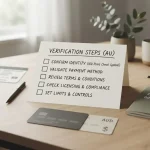
A real-money account is not just a username and password. Casinos conduct know-your-customer checks, often called KYC, and require identity verification before a withdrawal. That means you may be asked to show who you are and confirm that the payment method on the account belongs to you.
The timing can catch people out. You might be able to create an account and use its features before the checks are complete, then meet a request for documents when you try to withdraw. Treat verification as part of the account process from the start, not as an unexpected formality at the end.
The usual categories are straightforward:
The exact documents and submission steps can differ between services. Read the request carefully and check that the information on your account matches what you provide. A discrepancy can lead to more questions or a pause while the details are reviewed. Don’t send extra documents that were not requested.
Payment ownership matters for a practical reason: the name on a payment method is not merely a payment detail if the account is being checked. If another person’s card or account was used, you may have difficulty showing that the method belongs to you. It is safer not to assume you can resolve that later by explaining it.
Pause before uploading identity material, especially from a phone. Check that you are on the account service’s genuine site or app, and that the request appears within its own account or support process rather than in an unexpected message. A familiar logo is not proof that a request is genuine.
Look at what is being requested and why. If the instructions are unclear, ask the service through a contact route you have independently confirmed. Don’t send ID or payment details through a link in an unsolicited message. Keep a note of what you submitted and when, without making extra copies of sensitive documents where they could be exposed.
A secure connection can help protect information while it is being transmitted, but it does not tell you who will receive it or how the service will handle a dispute. That distinction matters with real-money accounts. An offshore service is not licensed in Australia merely because it asks for KYC documents or has a polished verification page. Unlicensed gambling services lack Australian consumer protections, and Australian laws may not assist if winnings are withheld.
If a request arrives when you seek a withdrawal, read it in full before responding. Check whether it asks for identity, address, or payment-ownership evidence, and whether the instructions explain how to submit it securely. Keep copies of messages and records of your replies. Avoid repeatedly sending different files to different contacts; that can make it harder to track what has been provided.
A request for documents does not, by itself, prove that a service is safe or that a withdrawal will be paid. It only tells you that the account is being checked. If the process feels unclear or the service asks for information that does not fit the stated purpose, stop and assess the risk before sharing anything further.
This is one reason I would not treat a real-money account as a casual sign-up. Identity checks can involve some of your most sensitive information. Know what is being requested, use a verified route to submit it, and remember that a mobile screen makes a document upload easy—not automatically wise.
PayID can make a casino deposit feel close to immediate, but the transfer is only one part of the process. A payment can move quickly through the banking system and still take longer to appear in an account if it has not yet been approved or released by the service receiving it. I keep those stages separate; “sent” and “available to play” are not necessarily the same status.
PayID transfers generally use Australia’s New Payments Platform (NPP). A specialist casino-payment review reports that a transfer can clear within minutes once it has been released. That is a description of what may happen, not a promise about every payment or every operator. The same kind of review notes that PayID and some e-wallet payments can be quick after approval, while bank transfers and card payments can take several business days. Timing depends on the payment route and the processing involved, so a fast transfer should not be read as a guaranteed instant deposit.
A specialist review notes that PayID and some e-wallet payments can be quick after approval, while bank transfers and card payments can take several business days.
The useful distinction is between the bank transfer and the receiving service’s handling of it. A PayID payment may have cleared, while the casino account still shows it as pending. The wording on the screen matters: a bank confirmation tells you about the transfer, not necessarily whether the receiving account has credited the funds. If the two do not match, check the transaction status and the service’s stated payment instructions before trying again. Sending a second payment because the first has not appeared can leave you with two transactions to resolve.
Before using PayID, read the deposit instructions carefully and check that the payment details shown at the point of payment match what your bank asks you to confirm. If the service gives you a reference or another instruction, follow it as displayed. Keep your bank confirmation and any transaction details; they make it easier to describe the issue if you need to contact the service or your bank. Do not assume that a transfer can be reversed simply because the account has not updated.
So, is PayID safe for a casino deposit? The payment method’s speed does not answer that by itself. It tells you something about how a transfer may move, not whether a casino is safe, properly authorised to serve Australians, or able to resolve a dispute. Nor does choosing PayID make an offer, including a no-deposit promotion, more trustworthy. Treat the payment method and the service receiving the money as separate questions.
I would also avoid treating “instant” as a useful guarantee. One step can finish quickly while another is still waiting for approval or account processing. A specialist payment review may describe quick transfers after release, but that is not a fixed service standard for every casino or every transaction. If a deposit is delayed, look for a clear explanation from the receiving service rather than relying on the payment method’s general reputation for speed.
PayID is therefore best understood as a transfer route, not a safety badge. Check the instructions, keep the confirmation, and distinguish a completed bank transfer from a credited casino balance. If the service cannot explain what stage a payment has reached, the quickness of PayID will not solve that problem. A fast transfer is still only a transfer.
A payment option shown beside a deposit button does not necessarily work in reverse. Depositing money and receiving a payout are separate transactions, and a service may support one route without supporting the other. Check the stated withdrawal methods and conditions before sending money; do not assume the method you used to pay in will be offered when you want to cash out.
POLi is a useful example. A specialist review describes it as mainly a deposit method, so treat any assumption that it can also handle withdrawals with caution. The cashier or payment terms should say what route is available for payouts. If they do not, ask for clear information before making a payment. Finding out only after a balance is held in an account is a poor time to discover the distinction.
Mainly a deposit method; do not assume it can handle withdrawals.
Withdrawals may be slower or unavailable depending on the processor.
Cards can have a similar mismatch. A specialist review notes that card withdrawals may be slower or unavailable, depending on the processor. A card accepted for a deposit therefore does not prove that a payout can be returned to that same card. The outcome depends on the payment setup behind the service, not simply on the logo displayed at checkout.
That matters when you are weighing whether a payment arrangement feels safe. A familiar payment method may make the deposit step seem straightforward, but it does not establish how a withdrawal will be handled or when funds will arrive. Look for the payout route in the written terms, including any stated conditions, and keep a copy of what the service says. If the terms conflict with the cashier screen, or the withdrawal route is left vague, do not treat the deposit option as an answer.
Keep the distinction plain: deposit availability is not payout availability. POLi is described in specialist coverage as primarily for deposits; card payouts may depend on the processor and may not be offered. Neither point tells you that a gambling service is authorised in Australia. Online casino services are not locally licensed for Australian residents, so a payment button should not be mistaken for local approval or a dependable route to recover money.
I would check the withdrawal information before considering any transfer, rather than relying on the deposit page to tell the whole story. If the service gives no clear explanation of how payouts work, that uncertainty is itself relevant. Familiar names, quick-looking checkout screens and a successful deposit are not substitutes for clear withdrawal terms.
A payment method is only one part of the route your money takes. Make sure you understand the difference before acting.
Before looking at a game’s return settings, keep the Australian legal position clear: online slots and casino games such as blackjack are illegal when offered to people in Australia. A familiar game title or a polished-looking game screen does not change that. Nor does an RTP label make the service lawful.
RTP means “return to player”. It describes a game’s theoretical return setting over extended play, not what you should expect from a particular session. A result can vary, and the RTP figure cannot tell you whether you will win or lose on a given visit. It is a game-mechanics detail, not a safety rating for the site offering the game.
To find a pokie’s stated RTP, open its information or help screen; the control is often marked with an “i” or tucked into a menu. Read the details for the version actually being offered. Some providers release the same game with different RTP settings, and the operator chooses which version to run. So recognising the title is not enough to know its return setting.
Return to Player describes a game’s theoretical return setting over extended play, not a guaranteed result for a particular session.
That small print matters if you are comparing game information, but it does not settle the bigger question of whether online casino games are safe or legally available in Australia. RTP says nothing about the operator’s legal status, how a dispute would be handled, or whether the return setting shown matches the version in use. Keep those questions separate.
If a site promotes “safe” games or a generous welcome offer, treat that wording as marketing rather than evidence about the game’s mechanics or legal position. The useful detail is the RTP information attached to the specific game version; it cannot turn prohibited online casino play into an authorised service. No magic setting.
A phone makes gambling easy to carry into the gaps in your day. That convenience is exactly why I’d check the play-control options before putting money into any gambling account, rather than hunting for them after a session has got away from me.
Look for a deposit-limit setting that lets you choose a daily, weekly or monthly cap. A specialist review describes these options on some online casino services; that is not a guarantee that every service offers them, or that a setting will take effect in the same way everywhere. Read the terms around changing a limit and check whether you can see your current limit in the account. A control you cannot find or understand is not much of a control.
On a mobile screen, small menus can bury the useful information. Check the account and responsible-gambling areas, and look for clear information about gambling-related harm and links to professional help in Australia. Reputable platforms provide this kind of information and direct players to support services. If those details are missing, difficult to locate or presented as an afterthought, take that seriously.
Also decide what you want your boundaries to be before you start: what you can afford to lose, and when you will stop. A limit can help you stick to a plan, but it cannot make gambling risk-free or guarantee that you will stop when you intend to. If you find yourself raising a cap to keep playing, chasing losses or hiding the activity from people close to you, pause and contact a professional support service rather than relying on another app setting.
Gambling Help Online is one Australian support service to look into. You do not need to wait until things feel unmanageable to seek help. If money worries are already part of the picture, the National Debt Helpline can also provide support with financial difficulty.
One important distinction: responsible-gambling features do not establish that an online casino is legally available in Australia. The Interactive Gambling Act bars operators from offering online casino games to people here, and a mobile-friendly interface does not change that. Safeguards are worth checking wherever gambling is involved, but they are not a substitute for support—or a reason to assume a service is safe for you.
Keep the controls visible. Keep the decision yours.
A padlock in the browser is useful, but it answers only a narrow question: is the connection encrypted? Casinos use SSL encryption to protect transactions and sensitive information as it moves between your device and the site. That does not tell you whether the service can legally offer casino games to people in Australia, whether it will handle a dispute fairly, or whether you can get help if it does not.
That distinction matters here. The Interactive Gambling Act 2001 prohibits operators from providing real-money online casino games to people in Australia. An offshore licence does not make an operator licensed in Australia. So when someone asks me whether an online casino is safe, I separate technical security from legal status and consumer protection. They are not interchangeable.
If an unlicensed service withholds winnings or mishandles a complaint, you may have limited practical recourse, and Australian laws may not assist you in recovering the money. A polished website, encrypted checkout and confident claims about fairness do not create the protections you might expect from a service authorised under Australian law. The small print can look reassuring. It is still small print.
For a check on what gambling products are legal in the market, ACMA has urged players to consult its website and the national register. That is a more useful starting point than treating a site’s own badge or offshore licence as proof that it is authorised to offer online casino games here. It also helps keep the question grounded: a secure connection is not a local licence.
I would not call a service safe for an Australian player just because it encrypts data. Encryption can reduce the risk of information being intercepted; it cannot guarantee fair treatment, recover a disputed balance or establish that the service is legally available to you. And a list of sites described as safe online casinos in Australia can blur those separate issues unless it makes clear what “safe” means.
Check the legal position and the limits of your protection before trusting a site with personal details or money. Security is one layer. It is not the whole safety net.
A VPN can make your internet connection appear to come from somewhere else. That does not make an online casino available or authorised in Australia. Using one to reach a casino may breach the operator’s terms, with serious consequences: winnings could be voided, your account closed and your deposit lost. A connection that seems to work is no guarantee you can get your money back.
I would not treat a VPN as a workaround. If a site is blocked from Australia, trying another route does not remove the underlying risk. ACMA can issue blocking orders as a last resort when it considers customer safety to be at risk. A block is a warning to take seriously, not a puzzle to solve.
The legal position matters here. Under the Interactive Gambling Act 2001, operators cannot provide real-money online casino games to people in Australia. The law does not explicitly make an individual player’s use of an offshore casino a criminal offence, but that is not the same as having consumer protection. If an unlicensed service withholds winnings, Australian laws may not help you recover them.
That applies whether you are trying to open a casino site in a browser or use a casino app. A safe-looking wallet, an Australian-dollar balance or a page that loads normally cannot establish that the service is legally available here. Nor does an online casino forum’s recommendation change the operator’s status.
If access fails, do not hand over identity or payment details just to get around the block, and do not assume that a successful login means the account is secure in the broader sense. Keep the distinction clear: a VPN changes how your connection appears; it does not grant a licence, create recourse or protect a deposit from the consequences of an account closure.
Better to stop there.
Licensed gambling services are required to follow responsible gambling rules; tools can include daily, weekly or monthly deposit limits, and information directing you to professional support for gambling-related harm. Real-money online casinos are not licensed in Australia.
Methods can include PayID, e-wallets, bank transfers and cards. POLi is mainly for deposits, while card withdrawals may be slow or unavailable.
PayID and some e-wallet withdrawals can be quick after approval, with PayID transfers often clearing within minutes once released. Bank transfers and card withdrawals can take several business days; card processing may also be unavailable.
The Interactive Gambling Act 2001 does not explicitly make it a criminal offence for an individual to use an offshore casino. However, operators are prohibited from offering real-money online casino games to Australians, and players should not assume an offshore service is locally licensed or provides Australian consumer recourse.