A practical look at Australian legal context, live-table claims, bonus terms and the limits of what can be verified.

A live-dealer casino is an online service where a real person presents a casino game through a video stream, while a player participates remotely. The screen may make the experience feel closer to sitting at a table, but it does not change the legal character of the service. If real money is involved, this is still online casino gambling.
That distinction matters in Australia. The Interactive Gambling Act 2001 prohibits companies from providing real-money online casino games to people in Australia. The restriction covers casino-style services, including live-dealer formats; putting a human presenter in front of a camera does not create an exception. There is no Australian-licensed online casino, and domestic licences for this kind of real-money online play have not been issued.
The law’s focus is the operator, rather than the individual who plays. Australians are not made criminally liable simply for using an offshore site that accepts them, and people may legally play on such sites. That is not the same as the service being approved or regulated in Australia. The operator’s legal position and the player’s position are different things.
Choosing a live dealer casino means finding an option that fits your priorities, from payment details to licensing information. Use these concise profiles to see what is known about each operator before deciding where to play.
Lucky Dreams
Lucky Dreams is listed with a Curacao license and a minimum deposit of A$20 via POLi. These details may help you assess whether its licensing and deposit option suit you.
Ricky Casino
Ricky Casino lists crypto payouts under an hour and PayID payouts in 1–3 business days. The minimum deposit is A$20, or A$30 to qualify for the bonus.
Neospin
Neospin lists a Curacao Gaming Control Board license, OGL/2023/176/0095, held by Hollycorn N.V. You can use this licensing information as one factor in your assessment.
Vegaz Casino
Vegaz Casino lists Curacao license OGL/2024/1335/0780 and a minimum deposit of EUR 20. Check whether those terms fit your preferences.
LuckyVibe
LuckyVibe lists a Curacao Gaming Control Board license, OGL/2023/176/0095, held by Hollycorn N.V. This gives you a specific licensing detail to consider.
DragonSlots Casino
DragonSlots Casino lists a Curacao Gaming Authority license, with Jumpman Gaming Ltd identified as the operator. You can consider this information when reviewing its credentials.
SkyCrown
SkyCrown lists a Tobique Gaming Commission license and a minimum deposit of A$30. Its stated payout times are around 10–15 minutes for crypto and 1–5 days for fiat.
Uptown Pokies
Uptown Pokies lists a Curacao license, says it has operated since 2017, and sets a minimum deposit of A$20. These details provide a concise snapshot for your review.
SpinsUp
SpinsUp lists a Curacao Gaming Control Board license, OGL/2023/174/0082, held by Dama N.V. You can weigh this licensing information when considering the operator.
7Bit Casino
7Bit Casino is listed as Curacao-licensed and operated by Dama N.V. The available details identify its jurisdiction and operator.
It is easy to blur those points when a site looks polished or uses familiar local language. A live stream, a sign-up page and an account balance can make an offshore service feel as if it belongs to the same system as a local business. They do not establish an Australian licence. There is no local online-casino licensing framework under which a site can be checked and treated as an approved domestic operator.
The Australian Communications and Media Authority, usually shortened to ACMA, is the main domestic regulator responsible for enforcing the Interactive Gambling Act. It can take action against illegal online gambling services, including blocking access to offshore sites. So an offshore service may accept Australian customers, but it should not be assumed to be reliably available from Australia. A site being reachable at one moment is not proof that it is operating lawfully here or that access will continue.
This is the part that often gets lost in the phrase “best live dealer casino online Australia”. A list of overseas services, however confident its wording, cannot turn them into Australian-licensed casinos. Nor does a foreign permit amount to a domestic licence. Those are separate regulatory arrangements, and only the latter would establish authorisation under Australia’s online-casino rules. No such domestic casino licence exists.
There is also a practical gap between being allowed to play as an individual and having local protection as a customer. If an offshore operator disputes an account or will not release winnings, Australian law does not give the player a local route to compel payment. That is not a minor detail tucked away in the terms. It is part of what choosing an offshore service means.
 Pokies by Region: Australian Casino GuidesExplore pokies and casino topics by Australian city and state, including Adelaide, Brisbane, Melbourne, Sydney, Tasmania and Western Australia.
 Adelaide Casino: Hotel, Dining and Visit DetailsLearn how to distinguish casino venue information from hotel bookings, and what to check in room offers, dining, parking and visit details.
I would treat “live dealer” as a description of presentation, not a badge of safety. It says something about how a game is shown; it says nothing by itself about Australian approval, the operator’s compliance, or what happens if a dispute arises. The legal starting point is plain: real-money online casino services are prohibited for operators serving people in Australia, while the law does not make the player liable merely for taking part.
That leaves an awkward but important picture for anyone considering live-dealer play from Australia. Offshore sites may be encountered and may accept local customers, yet they sit outside an Australian online-casino licensing system that does not exist. ACMA’s enforcement role also means access can be blocked. A familiar interface or a live presenter changes none of that. The format may look immediate; the protections are not local.
Live dealer play is presented as a table game run by a human dealer and streamed to a player’s screen. That is the basic idea behind searches for live casino games, but the label alone tells you little about what a particular site offers. It does not confirm which games are available, who supplies them, how tables operate, or whether a particular title can be played for real money.
That distinction matters if you are looking for blackjack. A page may use phrases such as “live blackjack” prominently, but a phrase is not proof of a working table or a clear account of its conditions. I would not treat a named game, provider or table as a recommendation unless the information can be checked against the actual service and its terms.
The word “live” describes a format, not a guarantee of quality. It does not establish that a feed is available at all times, that a table suits your preferred pace, or that the rules are the same from one place to another. Even familiar game names can conceal differences in table rules or conditions. Those details matter more than a glossy image of a dealer.
If you are comparing online live-dealer options, separate what is plainly stated from what is merely implied. Is the game actually identified as live dealer, or is the wording broad enough to cover other formats? Are the rules and table conditions displayed before you commit money? Can you tell what actions are available and what happens if a connection drops? If a page leaves those points fuzzy, do not fill in the gaps with assumptions.
A polished lobby is not evidence. Nor is a long list of game names, by itself, evidence that every listed table is available or that its details are accurate. The useful standard is straightforward: the game and its conditions should be visible to you before you play, and the claims should match what the service shows in practice. If they do not, pause rather than relying on a sales description.
 Real-money online pokies in Australia: legal and paymentThe Interactive Gambling Act 2001 targets operators, not individual players. Learn what to check on payments, withdrawals, offers and mobile play.
 Casino in Western Australia: Stay and Visit GuideLearn how to check whether accommodation is actually on-site and compare room details before booking, including bed setup, accessibility and included features.
Blackjack is a natural game to ask about because the rules are familiar to many players. But familiarity with the game does not make every live blackjack table equivalent. You still need to know the table rules, how decisions are made, and what the displayed limits and conditions mean. Do not assume that a live version follows the rules you remember from a pub, a casino floor or another website.
The same caution applies when a site describes itself as a live dealer casino. That label does not confirm that blackjack is among its offerings, and it does not establish the presence of any particular table. Search for the actual game information on the service itself, then read the rules before playing. If the page gives you no usable detail, that is a reason not to rely on the claim—not an invitation to guess.
I would also avoid treating a provider’s name as a shortcut to certainty. A provider label, where one is shown, does not tell you the table’s full rules or prove that the experience matches a description elsewhere. Verify the specific table rather than assuming a brand name settles the question.
Before you play any live table, check what you are choosing and what controls are available to you. Deposit limits can help cap how much you put in; loss limits can set a boundary on losses; session time limits can interrupt a long stretch of play; and self-exclusion gives you a way to step away. These are practical tools, not a promise that gambling will be harmless. Set limits before you start, while you are not caught up in a session.
Also make sure you understand the table’s rules and conditions before staking money. If the information is hard to find, contradictory or described only in promotional language, do not proceed on the strength of the presentation. A camera and a dealer do not make unclear terms clearer.
Live blackjack may be the game you have in mind, but responsible choice begins with details you can actually inspect: the named game, its rules, the table conditions and the controls available to you. Without those, “live dealer” is only a label. Details first.
A live-dealer bonus can look generous until you work out what the wagering condition asks you to do. The headline amount is not the useful number. The useful number is the total turnover required before any winnings become withdrawable, and whether the calculation applies to the bonus alone or to your deposit as well.
There is an important Australian context before you get to the arithmetic: real-money online casino games cannot lawfully be offered to people in Australia by operators under the Interactive Gambling Act 2001. There is no Australian-licensed online casino. So treat any offshore bonus claim as a claim to scrutinise, not as an endorsement or evidence of local approval.
A specialist review suggests looking for a wagering multiplier of 35x or less and describes anything above 40x as punishing. That is a review’s assessment, not a rule or guarantee about what an offer is worth. The wording in the terms matters: the same multiplier can produce a very different turnover target depending on what amount it applies to.
 Best Aussie Pokies Online in Australia: What to KnowExplore free play, PayID, bonus terms and game-list claims. The Interactive Gambling Act prohibits real-money online pokies without a domestic licence.
 Best pokies in Adelaide: venue and play checksLearn how to verify gaming-area hours, assess venue listings and understand the limits of “best” claims; general opening times may not confirm…
Take the stated example of a $500 bonus with a 40x requirement. If the multiplier applies to the bonus alone, the arithmetic is:
$500 × 40 = $20,000 in required bets.
A specialist review uses this example to illustrate that the winnings cannot be withdrawn until that turnover has been completed. In practical terms, the bonus is not cash you can simply collect. You would have to place a large volume of bets, with the possibility of losing money along the way. Completing the requirement does not guarantee a profit.
Now compare a deposit-plus-bonus calculation. If you deposit $500 and receive a $500 bonus, the amount subject to a 35x requirement is $1,000:
($500 deposit + $500 bonus) × 35 = $35,000 in bets.
The multiplier is lower than in the first example, yet the total required turnover is higher because it applies to the combined amount. That is why “35x” or “40x” on its own tells you very little. Find the exact base amount in the terms, then multiply it by the stated requirement.
For any advertised welcome offer or no-deposit promotion, first identify what the promotion actually gives you and what conditions attach to it. Is the wagering requirement based on the bonus, the deposit, or both? Do the terms explain which bets count towards turnover? Do they say whether live-dealer play contributes at all, or whether it is excluded? Do not assume that a live table qualifies just because the promotion appears on a casino page that also advertises live games.
Calculating Wagering
Identify the base amount
Determine if the multiplier applies to the bonus alone or to the combined deposit and bonus.
Perform the multiplication
Multiply the base amount by the wagering requirement (e.g., $500 bonus × 40 = $20,000 in bets).
Verify withdrawal conditions
Check for any additional restrictions, such as cash-out caps on winnings from free spins.
If the terms do not make the calculation clear, you cannot reliably estimate the amount of betting required. A banner or short offer description is not a substitute for the full conditions. Look for the wording that defines the wagering base and the rules that apply before withdrawal; if those details are hard to locate or ambiguous, the headline figure is not enough to judge the offer.
A specialist review also notes that free-spin offers may limit how much of the resulting winnings can be cashed out. That is a separate restriction from wagering: even if you satisfy a turnover condition, a cash-out cap can still limit what you receive. Check whether a cap applies and what amount it covers rather than assuming that winnings shown on screen are all withdrawable.
A larger bonus is not automatically better, and a lower multiplier is not automatically easier. Work out the turnover using the correct base, then read the other restrictions alongside it. A promotion can require substantial betting before withdrawal and may have further conditions that affect the final amount. The numbers describe the requirement; they do not predict whether you will win.
The same discipline applies to claims framed as a “best” live-dealer bonus or a no-deposit deal. Those labels do not tell you the wagering base, whether table bets count, or whether a withdrawal cap applies. Do not treat a promotional label as proof that an offer is available to Australians, lawful here, or suitable for you.
Most importantly, do not deposit money just to unlock a bonus. If you are considering an offshore offer, remember that Australian law does not provide a local licensed casino framework for it. A promotion cannot remove that risk, and completing its wagering terms does not create a right to be paid in Australia.
The quick check is simple: identify the amount the multiplier applies to, do the multiplication, and read the withdrawal conditions. If you cannot establish those basics from the terms, you cannot sensibly compare the headline offer with another. The headline is the easy part.
Bitcoin may appear in descriptions of offshore gambling, but a mention of cryptocurrency is not proof that a particular live-dealer casino accepts it. Treat those as separate questions, not one broad promise.
That distinction matters because “crypto accepted” can leave the practical details unclear. A site might describe a payment option without making clear whether it applies to casino play, whether it is available to Australian customers, or whether it works for both deposits and withdrawals. Unless the operator’s current terms answer those points, you have a claim to check, not a settled payment route.
The same care applies to words such as “instant” or “anonymous”. They do not tell you what checks may be required, what conditions attach to a withdrawal, or whether the payment method is available to you. I would not make a money decision based on a coin logo or a general statement on a landing page. Read the payment terms that apply to your account, and look for specific wording about both directions of transfer.
There is a separate legal point. Australian law targets the operator providing prohibited online gambling services; it does not make an individual player liable simply for playing. Australians can legally play on offshore sites that accept them. That does not turn an offshore casino into an Australian-licensed business, nor does it make a cryptocurrency payment evidence of approval or protection.
In other words, legality for the player and the reliability of a payment claim are different matters. A site accepting Australian customers does not, by that fact alone, establish that it accepts crypto. And a site claiming to accept Bitcoin does not, by that claim alone, establish that the service is lawful for the operator to provide in Australia.
If you are considering a site that advertises crypto, check whether its terms name the relevant currency and explain deposit and withdrawal conditions for Australian customers. Be wary of wording that is broad enough to sound reassuring but leaves those details unresolved. Also check whether the account, payment and identity details you would need to provide are consistent with the operator’s stated process. A crypto option does not remove the need to understand the site’s rules.
I would keep the decision plain: do not assume that a live table can be funded with Bitcoin just because a casino mentions crypto somewhere on its site. Do not assume that a deposit route also works for cashing out. And do not confuse being legally able to play as an individual with having the same protections you would expect from a domestic service. Those are different questions, and the payment label answers neither by itself.
A review can sound careful and still leave out the detail that matters when you try to withdraw. I read these pages as claims to check, not as proof that a site is safe, fair or suitable. In Australia, that distinction matters: there is no Australian-licensed online casino, and the law prohibits operators from providing real-money online casino games to people here.
 Online Keno in Australia: Legal Guide and ChecksLearn why Australia has no locally licensed real-money online casinos, and what to check around withdrawals, game randomness, bonuses and offshore sites.
 Canberra Casino Guide: Hotels, Games and Venue DetailsLearn how to check a casino’s operating status and official address, assess hotel proximity, and make sense of searches about games, dining…
Start by asking who is speaking. Is the review based on an actual account and a documented check, or does it simply repeat an operator’s own description? Does it explain how the reviewer reached a conclusion, or lean on broad labels such as “trusted” and “fast”? A confident tone is not evidence. If the page does not distinguish what it checked from what it was told, treat its verdict accordingly.
When a review names a live-dealer provider or describes the casino software, look for specifics that can be checked: the provider’s name, where that information appears, and whether the review makes clear what it has independently confirmed. A provider logo or a polished lobby is not, by itself, evidence about how a particular service operates. Nor does naming a software company establish the terms that apply to your account.
Be especially cautious with claims about fairness, game settings or technical safeguards. A review should point to clear supporting information rather than asking you to take a general assurance on trust. If it cannot show what it checked, the honest conclusion is that the claim remains unconfirmed. I would not treat a long list of provider names as a substitute for that explanation.
The same goes for praise about an easy-to-use site or a smooth live table. Those are judgements, not guarantees of performance for you. A review may describe its own experience, but that does not prove every session, device or account will work the same way. Keep the distinction clear: what the reviewer observed is not automatically a promise about what you will get.
If a review calls withdrawals simple, find the actual terms and read them yourself. Look for the conditions that apply after a request is submitted: what documents are required, how the operator handles a review of your account, and whether a stated withdrawal cap could restrict how much is paid at once. A large advertised win tells you little about how it can be withdrawn.
Specialist reviews have reported that some casinos set weekly or monthly withdrawal caps in the $5,000–$10,000 range; one example discussed a $50,000 jackpot becoming a multi-year payout plan. Treat that as a warning about the kind of condition to investigate, not as a current rule for every operator. Check the terms that apply to the specific account and do not rely on a review’s summary if the underlying wording is available.
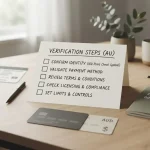
Then check how the review describes identity checks. Specialist reviews report that casinos may require verification before a first withdrawal, including identity and address documents and, in some cases, a selfie holding identification. The practical point is simple: read the operator’s stated document requirements before depositing, and complete the required identity and address checks before requesting a withdrawal. Do not assume that a review’s claim of “quick payouts” means those checks can be skipped.
Look for whether the review explains what happens if documents are unclear, rejected or requested again. If it says little beyond “verification is required,” that is not enough to understand the process. Keep copies of the terms and any relevant account communications. If the operator changes or applies its conditions in a way you did not expect, a review’s positive verdict will not resolve the dispute.
“Free” can describe a promotional label, not money you can freely withdraw. Read the rules attached to any free-play claim: whether registration or a deposit is required, what restrictions apply to winnings, and whether a cash-out cap is stated. A review that highlights the headline but skips the conditions has not given you the full picture. Keep this separate from the question of whether the site itself is trustworthy; a promotional offer cannot answer that.
The same test applies to bonus reviews. Check whether the reviewer links to the terms and makes clear which conditions apply, rather than repeating an enticing headline. Do not infer that an offer is available to you just because it appears in an article; promotional terms can change, and eligibility may depend on the operator’s rules. If the review cannot establish the terms, do not treat its description as settled.
A “free” table or demonstration mode is also not evidence that real-money play is permitted or protected in Australia. The law targets operators, not individual players, but offshore services are not Australian-licensed casinos. BetStop applies only to Australian-licensed operators; it does not bind offshore sites. A review that leaves out those limits is leaving out important context.
Before trusting a recommendation, see whether the page separates tested details from operator claims, links to withdrawal and verification terms, and explains what it could not confirm. Check that the review is consistent: a glowing summary should not sit beside unclear conditions or unanswered questions about cash-outs. If the page tells you to act quickly but gives you no way to verify its claims, slow down.
I look for plain answers, not polished adjectives. Who checked the information? Where are the applicable terms? What happens before a withdrawal is approved? If those questions are left hanging, the review has not done the work its verdict suggests. A review can help you spot questions. It cannot supply Australian legal protection for an offshore account.
A phone screen can make a roulette table look close at hand. That says nothing about whether the service is lawful in Australia, whether a particular game works on your device, or whether the controls are any good. I’d separate those questions before getting distracted by presentation.
Real-money online casino games, including roulette, cannot lawfully be provided to people in Australia under the Interactive Gambling Act 2001. There is no Australian-licensed online casino. A mobile-friendly page or an offshore licence does not change that position, so I wouldn’t treat a polished interface as a sign of local approval.
If you are assessing a site’s claims, look for responsible-gambling controls described plainly and available before you consider signing up. Deposit limits can restrict what you put in; loss limits can help cap losses; session time limits can interrupt a long stretch of play; and self-exclusion can block access. These are standard tools, but their presence on a page does not establish how a particular offshore service applies them. Read the terms and check what the operator says happens when a limit is reached or a self-exclusion request is made.
A small screen can make it easier to lose track of time or money. Set a personal stopping point before you open anything, and don’t raise it in the moment to recover losses. If the controls are hard to find, unclear, or framed as optional extras, take that seriously. A control you cannot understand is not much of a control.
One Australian service name needs a careful distinction: BetStop applies to Australian-licensed operators and does not bind offshore sites. Since Australia has no licensed online casinos, do not assume that registering with BetStop will prevent access to an offshore casino. It is not a substitute for checking the limits of the service you are dealing with.
The same caution applies to mobile roulette claims. Words such as “live” or “mobile” describe how a product is presented, not whether it is safe, legally available here, or subject to Australian protections. I would not infer any of those things from a demo, a screenshot, or a promise that a page is designed for phones.
Before spending time on a site, find its responsible-play information and see whether the controls are explained in specific, readable terms. If you cannot tell how to set a limit, pause play, or request exclusion, don’t fill in the gaps with optimism. A tidy screen is not a safety net.
The legal distinction is easy to miss when you are looking at an offshore live-dealer table. Australian law targets the companies that provide prohibited real-money online casino services to people here. It does not make an individual player criminally liable simply for using an offshore site that accepts Australian customers. That is not the same as saying the arrangement is protected or risk-free.
If you choose to play for real money, you are dealing with an operator outside Australia’s local licensing system. A live stream, a polished cashier or a familiar table format does not change that. The service is still offshore, and the safeguards available to you are not those of an Australian-licensed online casino. There is no such local casino licence to fall back on.
The practical problem becomes sharp when something goes wrong with a withdrawal. If an offshore casino refuses to pay winnings, Australian players have no legal recourse in Australia to make it pay. You may be able to contact the operator and pursue its own complaints process, but that is not the same as having an Australian authority or court able to enforce your claim against it.
That gap matters before you deposit, not just after a dispute. When you consider an online casino offering live dealer games for real money, be clear-eyed about who holds your money and where you would have to turn if the operator disputes a balance or declines a payout. A site’s willingness to accept Australians does not give you local consumer protection.
I would treat the possibility of losing access to winnings as part of the cost of choosing an offshore real live-dealer casino. If that risk is not one you can accept, do not deposit. No table is worth confusing legal permission for the player with a promise of help when an operator fails to pay.
A polished page can make a live-dealer casino look like an easy choice. I would not treat a “top” label, a tidy comparison table or a familiar-sounding licence as proof that an operator is safe for someone in Australia. There is no Australian-licensed online casino, and the law prohibits operators from providing real-money online casino games to people here. Offshore access can also be blocked by the authorities. That is the starting point, not fine print.
If you are comparing claims about a casino with live dealer, begin with what the operator says will happen when you want your money back. Find the withdrawal terms before depositing. Check which payment methods are eligible, whether the operator can request documents, how it handles a disputed payment and what conditions could delay or prevent a withdrawal. If the terms are vague, contradictory or hard to locate, that is information in itself.
Identity checks matter too. A specialist review reports that casinos may ask for identity documents before a first withdrawal, including proof of identity and address, and sometimes a selfie holding an ID. Read the operator’s own requirements and prepare for verification before you deposit; do not assume that creating an account means you are ready to cash out. A document request at the withdrawal stage can become a serious problem if the rules were unclear from the start.
I would also separate table presentation from protection. A live studio, dealer or busy-looking lobby does not establish that an operator is licensed in Australia, nor does a ranking prove that a payout dispute will be resolved in your favour. Australia has no local online casino licence to check against. If an offshore operator refuses to pay, Australian players have no legal recourse in Australia to recover those winnings.
So I would not call any offshore site the best choice for Australians on the basis of a badge or a review score. Compare the written terms, verify the company details as far as you can, and be honest about the limit: careful reading can help you spot warning signs, but it cannot supply Australian legal protection. That distinction is easy to miss. It matters most when something goes wrong.
There is no Australian-licensed online casino, so an offshore site is not approved under an Australian online-casino licensing system. If it refuses to pay your winnings, you have no legal recourse in Australia.
It is the amount you must bet before bonus winnings can be withdrawn. For example, a $500 bonus with a 40x requirement means $20,000 in bets; if the requirement applies to a $500 deposit plus a $500 bonus at 35x, it means $35,000 in bets.
E-wallets such as Skrill and Neteller are popular for their speed, though that does not guarantee a fast withdrawal from a particular site. PayID transfers can also be blocked by some Australian banks when they involve known gambling merchants.
Each spin is an independent random event determined by a Random Number Generator. However, some providers let casinos choose between different RTP settings for the same game, so the return percentage can vary between casinos.
Compare the bonus with the wagering required before you can withdraw: a $500 bonus at 40x requires $20,000 in bets, while a 35x requirement on a $500 deposit plus a $500 bonus means $35,000. Also check for cash-out caps on free-spin winnings and withdrawal limits that could restrict access to larger wins.